


Why reading matters more than ever
A feature on the school's reading and literacy programme, published in The Holderness and Hornsea Gazette - June 2026.
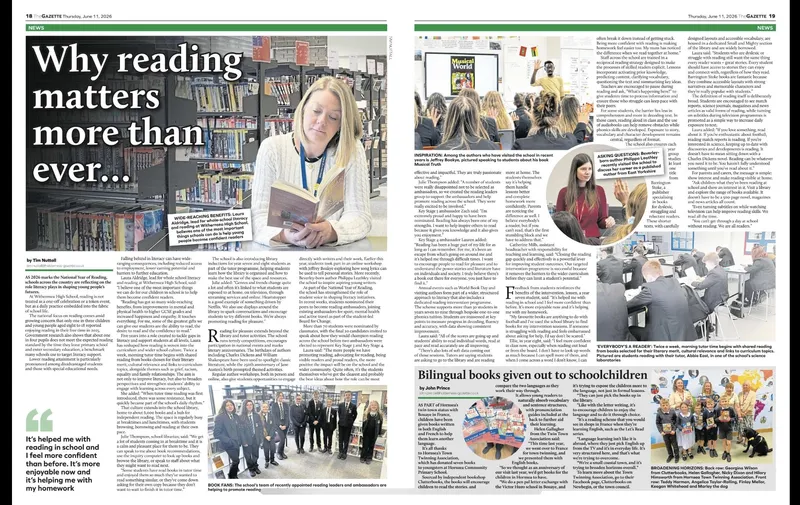
As 2026 marks the National Year of Reading, schools across the country are reflecting on the role literacy plays in shaping young people’s futures. At Withernsea High School, reading is not treated as a one-off celebration or a token event, but as a daily practice embedded into the fabric of school life.
The national focus on reading comes amid growing concern that only one in three children and young people aged 8 to 18 reported enjoying reading in their free time in 2025. Government research also shows that around one in four pupils do not meet the expected reading standard by the time they leave primary school and enter secondary education, a benchmark many schools use to target literacy support.
Lower reading attainment is particularly pronounced among disadvantaged students and those with special educational needs. Falling behind in literacy can have wide-ranging consequences, including reduced access to employment, lower earning potential and barriers to further education, making strong reading skills a vital foundation for future success.
Reflecting on the scale of the challenge and the responsibility schools carry, Laura Aldridge, lead for whole school literacy and reading at Withernsea High School, said: “I believe one of the most important things we can do for our children in school is to help them become confident readers. Reading has got so many wide-reaching benefits, from improvements in mental and physical health to higher GCSE grades and increased happiness and empathy. It touches everything. For me, some of the greatest gifts we can give our students are the ability to read, the desire to read and the confidence to read.”
Five years into a role created to tackle gaps in literacy and support students at all levels, Laura has reshaped how reading is woven into the curriculum and wider school culture. Twice a week, morning tutor time begins with shared reading from books chosen for their literary merit, cultural relevance and links to curriculum topics, alongside themes such as grief, racism, equality and family relationships. The aim is not only to improve literacy, but also to broaden perspectives and strengthen students’ ability to engage with learning across every subject.
Acknowledging the time and effort involved in embedding a reading culture, Laura said: “When tutor time reading was first introduced, there was some resistance, but it quickly became part of the school’s daily rhythm.”
That culture extends into the school library, home to around 6,000 books and a hub for independent reading. The space is regularly busy at breaktimes and lunchtimes, with students browsing, borrowing and reading at their own pace.
Julie Thompson, school librarian, said: “We get a lot of students coming in at breaktime and it is a calm and pleasant place for them to be. They can speak to me about book recommendations, use the enquiry computer to look up books and browse the library, or speak to staff about what they might want to read next.
“Some students have read books in tutor time and enjoyed them so much they’ve wanted to read something similar, or they’ve come down asking for their own copy because they don’t want to wait to finish it in tutor time.”
The school is also introducing library inductions for Year 7 and Year 8 students as part of the tutor programme, helping students learn how the library is organised and how to make the best use of the space and resources available.
Reflecting on changing reading trends during more than 25 years as school librarian, Julie added: “Genres and trends change quite a lot and often it’s linked to what students are exposed to at home, on television, through streaming services and online. ‘Heartstopper’ is a good example of something driven by Netflix. We also use displays around the library to spark conversations and encourage students to try different books. We’re always promoting reading for pleasure.”
Reading for pleasure extends beyond the library and tutor activities. The school runs termly competitions, encourages participation in national events and marks literary anniversaries. The birthdays of authors including Charles Dickens and William Shakespeare have been used to spotlight classic literature, while the 250th anniversary of Jane Austen’s birth prompted themed activities.
Regular author workshops, both in person and online, also give students opportunities to engage directly with writers and their work. Earlier this year, students took part in an online workshop with Jeffrey Boakye exploring how song lyrics can be used to tell personal stories. More recently, Beverley-born author Philippa Leathley visited the school to inspire aspiring young writers.
As part of the National Year of Reading, the school has strengthened the role of student voice in shaping literacy initiatives. In recent weeks, students nominated their peers to become reading ambassadors, joining existing ambassadors for sport, mental health and active travel as part of the student-led Board for Change.
More than 70 students were nominated by classmates, with the final 20 candidates invited to speak about how they would champion reading across the school before two ambassadors were elected to represent Key Stage 3 and Key Stage 4.
Reflecting on the role, Laura said: “The more people we have promoting reading, advocating for reading, being visible readers and proud readers, the more positive the impact will be on the school and the wider community. Quite often, it’s the students themselves who’ve got the clearest and probably the best ideas about how the role can be most effective and impactful. They are truly passionate about reading.”
Julie Thompson added: “A number of students were really disappointed not to be selected as ambassadors, so we created the reading leaders group to support the ambassadors and help promote reading across the school. They were really excited to be involved.”
Key Stage 3 ambassador Zach said: “I’m extremely proud and happy to have been nominated. Reading has always been one of my strengths. I want to help inspire others to read because it gives you knowledge and it also gives you enjoyment.”
Key Stage 4 ambassador Lauren added: “Reading has been a huge part of my life for as long as I can remember. For me, it’s been an escape from what’s going on around me and it’s helped me through difficult times. I want to encourage people to read for pleasure and to understand the power stories and literature have on individuals and society. I truly believe there’s a book out there for everyone, you just have to find it.”
Annual events such as World Book Day and visiting authors form part of a wider, structured approach to literacy that also includes a dedicated reading intervention programme. The scheme currently supports more than 30 students in Years 7 to 9 through bespoke one-to-one phonics tuition. Students are reassessed at key points to measure progress in decoding, fluency and accuracy, with data showing consistent improvement.
Explaining the impact of the provision, Laura said: “All of the scores are going up and students’ ability to read individual words, read at pace and read accurately are all improving.
“There’s also lots of soft data coming out of those sessions. Tutors are saying students are asking to go to the library and are reading more at home. The students themselves say it’s helping them handle lessons better and complete homework more confidently. Parents are noticing the difference as well. I believe everybody’s a reader, but if you can’t read, that’s the first stumbling block and we have to address that.”
Catherine Mills, assistant headteacher with responsibility for teaching and learning, added: “Closing the reading gap quickly and effectively is a powerful lever for improving student outcomes. Our targeted intervention programme is successful because it removes the barriers to the wider curriculum before they can limit a student's potential.”
Feedback from students reinforces the benefits of the intervention. A Year 7 student said: “It’s helped me with reading in school and I feel more confident than before. It’s more enjoyable now and it’s helping me with my homework.
“My favourite books are anything to do with football and I’ve used the school library to find books for my intervention sessions. If someone is struggling with reading and feels embarrassed about asking for help, I’d say don’t be scared.”
A Year 8 student added: “I feel more confident in class now, especially when reading out loud or from the board. I don’t have to look up words as much because I can spell more of them, and when I come across a word I don’t know, I can often break it down instead of getting stuck. Being more confident with reading is making homework feel easier too. My mum has noticed the difference when we read together at home.”
Staff across the school are trained in a reciprocal reading strategy designed to make the processes of skilled readers explicit. Lessons incorporate activating prior knowledge, predicting content, clarifying vocabulary, questioning the text and summarising key ideas. Teachers are encouraged to pause during reading and ask, “What’s happening here?” to give students time to process information and ensure those who struggle can keep pace with their peers.
For some students, the barrier lies less in comprehension and more in decoding text. In those cases, reading aloud in class and the use of audiobooks can help remove obstacles while phonics skills are developed. Exposure to story, vocabulary and character development remains central, regardless of format.
Laura said: “It’s about changing what reading means. With the way technology has evolved, people can engage with reading in so many different ways now. It’s exposure to vocabulary, stories, characters and meaning.
“You don’t always have to see the word on the page to engage with a story. Audiobooks can do all of that too. We all love stories, that’s why we gossip. Stories are for everybody.”
The school also ensures each year group studies at least one title from Barrington Stoke, a publisher specialising in books for dyslexic, struggling and reluctant readers. These shorter texts, with carefully designed layouts and accessible vocabulary, are housed in a dedicated ‘Small and Mighty’ section of the library and are widely borrowed.
Laura said: “Students who are dyslexic or struggle with reading still want the same thing every reader wants - great stories. Every student should have access to stories they can enjoy and connect with, regardless of how they read. Barrington Stoke books are fantastic because they combine accessible layouts with strong narratives and memorable characters and they’re really popular with students.”
The definition of reading itself is deliberately broad. Students are encouraged to see match reports, science journals, magazines and news articles as valid forms of reading, while turning on subtitles during television programmes is promoted as a simple way to increase daily exposure to text.
Laura added: “If you love something, read about it. If you’re enthusiastic about football, reading match reports is reading. If you’re interested in science, keeping up to date with discoveries and developments is reading. It doesn’t have to mean sitting down with a Charles Dickens novel. Reading can be whatever you need it to be. You haven’t fully understood something until you’ve read about it.”
For parents and carers, the message is simple: show interest and make reading visible at home.
“Ask children what they’ve been reading at school and show an interest in it. Visit a library and explore the range of books available. It doesn’t have to be a 500-page novel, magazines and news articles all count. Even turning subtitles on while watching television can help improve reading skills. We read all the time. You can’t get through a day at school without reading. We are all readers.”
Through daily tutor reading, targeted intervention, student leadership and an inclusive understanding of what reading can look like, Withernsea High School aims to ensure reading is not seen as a niche hobby or an academic hurdle, but as an essential life skill accessible to every student.
Why reading matters more than ever - The Holderness and Hornsea Gazette
| Name | Format | ||
|---|---|---|---|
| Files | |||
| The Holderness Hornsea Gazette - Holderness Gazette June 11 2026 - p18-19.pdf |